
“How has your week been?” my friend asked.
“I’ve been struggling a bit, actually“ I said.
“With work?”
“Work, home, exercise, everything! Nothing unusual has happened, but somehow it all feels harder the past week.” I tried to explain.
“Last week, I could get through the workouts, have a full day at work and still have the patience to read to the kids every night. This week, I’m in a meeting - a colleague is talking to me and I’m struggling to follow. I deeply care about what they’re saying. I want to be there, but I’m just finding it hard.”
“Are you getting enough sleep?” asked my friend.
“Yeah, mostly. What I don’t understand is some days despite getting a good night’s sleep of 7+ hours, I still felt exhausted.”
There was so much to fit into a day: work, the children, things to organise at home, staying in touch with my family back home. Saying it aloud, I knew it sounded like I was describing being busy.
“But all those things were there last week too,” I said. “How could I manage them then?”
That was what I kept wondering about. On the days when I felt well, all my plans seemed reasonable. I wanted to have those conversations, spend time with my family and make room for myself too. But then a difficult day would arrive and I’d end it wondering why I signed up for so much or why I hadn’t managed half of what I’d intended. It affected my relationships too, particularly with my husband. A small remark or an everyday request would land very differently on those days. I felt much more sensitive and it was harder to step back from what I was feeling. Things that wouldn’t usually bother me would turn into conflict between us. That was another difficult part of trying to understand these changes: they were affecting the people closest to me as well.
Trying to understand the changes
I spent years trying to understand those changes. Some days, I felt so overwhelmed that I knew I needed support. I tried therapy too. There were sessions that really helped and then there were also days when I arrived feeling so happy and well that I struggled to explain what had felt so difficult when I’d booked the appointment or why I’d needed the session in the first place.
Then the difficult days would return and I would need that support again. I wanted to understand why something could feel so overwhelming one day and so distant the next. Eventually, I went to my GP for help. By then, I’d spent so many nights lying awake, worrying and feeling anxious, that it was taking a toll on how I felt and managed the following day. Over time, we explored different explanations and I had blood tests to check for deficiencies and look at my hormone levels. All the results came back within normal ranges, but I was still struggling with changes that affected almost every part of my daily life.
I started looking online, trying to understand what was happening to me. At first, I read forums where other women were sharing their experiences, which led me to read about PMS and PMDD. By the next day, my Instagram feed seemed to be full of reels about both. Some of what I was watching and reading sounded familiar and I began to wonder whether the changes I was experiencing followed a pattern in my own cycle.
I tried a few apps to keep track, but many of the ones I found seemed focused on fertility, which wasn’t what I was trying to understand. I also found the number of questions frustrating, especially on days when I was already struggling. I wanted to record what was happening in my life alongside the symptoms, so I could look back at both together and figure out what helped when those days were happening. With the apps I tried, I couldn’t find a way to keep everything I wanted in one place and I still had to work through the data myself to make sense of it. Eventually, I started tracking in a spreadsheet, where I could choose what to record along with the everyday details I wanted to look back on, to better understand what might help.
Looking at the big picture
After three months of tracking, a pattern became clear. I could see that the most intense changes were happening seven to ten days before my period. Almost like clockwork, I would start struggling to sleep, my anxiety would rise (sometimes for no reason) and I would experience lower back pain and breast tenderness. When my period began, I often felt as though the fog had lifted. I had experienced this many times, but seeing it across several months helped me recognise how regularly it was happening.
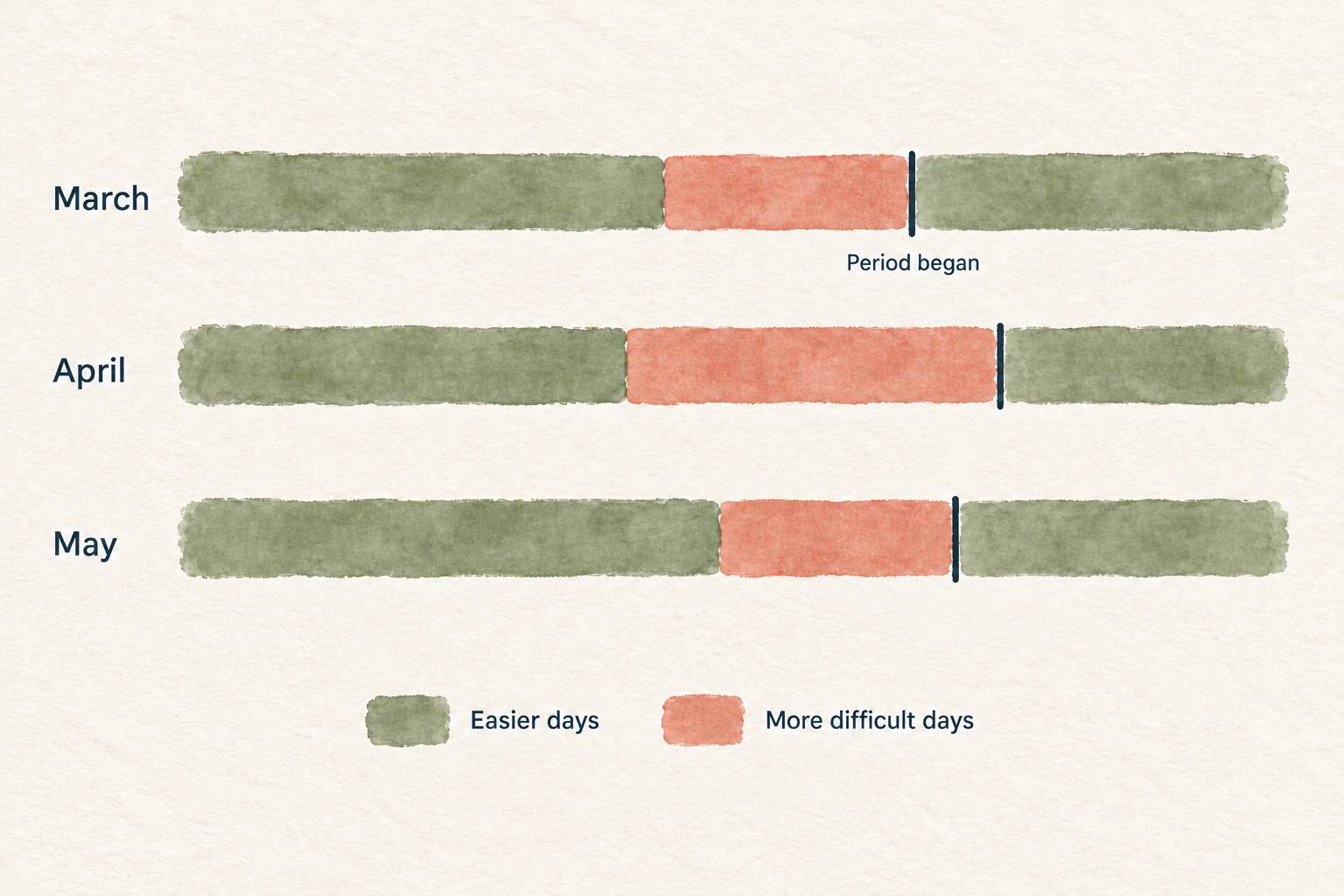
I took the chart to my next GP appointment. Showing it to her made it easier to explain when the symptoms appeared, how they affected my life and when they eased. Previously, I had struggled to describe the difficult days when I was feeling well. Now I had a record of both and we could talk about what was happening across the month rather than relying on how I felt that day. It still took a lot more research, reading and conversations with my GP to find a treatment approach that helped. But when we did, I remember thinking: Oh my God, I can feel this calm before my period? These were the days when my anxiety would usually take over and keep me awake. For the first time in years, I was experiencing those days differently and I hadn’t realised that was possible. It got me thinking about how many other women might still be going through what I had, trying to explain how they felt, asking for help and wondering why they couldn’t find an answer.
Making sense of your own experience
If some of this feels familiar, you may be wondering whether your cycle plays a part too. PMS can involve emotional and physical symptoms in the two weeks before a period, including anxiety, tiredness, sleep difficulties and breast tenderness. These usually improve after the period starts. The exact cause is uncertain, but some women are sensitive to normal hormonal changes during their cycle. That timing was useful context for me, though recognising parts of my story doesn’t mean your experience has the same explanation. [1]
If you want to start recording how you feel, keep it simple enough to fit into your life. You could note your mood, energy, sleep and any physical symptoms, alongside your period dates. Add relevant details for that day: a demanding afternoon, a conversation that upset you or something that seemed to help. Include the good days too. For me, seeing that I had more good days than difficult ones was reassuring. It was easy to lose sight of that when I was struggling and having it written down certainly helped me remember that this too shall pass :)
You don’t need to know what you’re looking for before you begin. For assessing a possible premenstrual pattern, RCOG recommends keeping a symptom diary for at least two consecutive cycles and reviewing it with a healthcare professional. [1] You can ask for help while you’re building that record. If tiredness is affecting your daily life or has continued for several weeks without an explanation, speak to your GP rather than assuming it is cycle-related. [2] I also used a symptom tracker from the International Association for Premenstrual Disorders (IAPMD). If you’d prefer a structured starting point, their free downloadable tracker is designed to help you record symptoms daily and bring that record to a healthcare appointment. [3]
If this helps even one woman feel less alone
By the time I found an approach that helped, I had spent five or six years struggling with these changes month after month and trying to understand what was happening. That experience is why I started building Synkra. I kept thinking about how much effort it had taken to record everything, make sense of it and explain it to someone else. I wanted to make that process easier for other women, with room for what was happening in their lives alongside how they felt.
I wish I’d started paying attention sooner to how I felt across the month, including the days when life felt good. For years, I could tell you what was in my calendar more easily than I could explain what was happening to me. Keeping a record gave me something to look back on, ask questions about and bring into conversations about my health. If you see yourself in any of this, I’d recommend starting with simply how today has felt. What felt manageable, what was difficult and what else was going on? You don’t need to have an explanation before you write it down. The next time someone asks, “How has your week been?”, you might find yourself pausing to consider the answer and giving your own wellbeing the attention it deserves.
References
[1] Royal College of Obstetricians and Gynaecologists. Managing premenstrual syndrome (PMS).